

Wattching Movies: Watt A Life
- Watt

- Dec 29, 2022
- 23 min read
Updated: Jun 3, 2023
Inspired by a Letterboxd list from one of my favorite comedy writers Demi Adejuyigbe and my impending ascent to middle age, I decided to take a look back at my favorite movie from each of the years of my life. This is not my official accounting of the best film in each year, though it often overlaps, but rather putting a spotlight on the films that loom largest in my wistful mind. These are the movies that made me laugh hardest, drop my jaw the lowest, or avoid making watery eye contact the longest. They are the quote machines that interjected themselves into my daily conversations. A slew of motion pictures with characters I would try to wholesale poach my personality from. I’ll be updating this list with a new year’s selection each day as the big 3-0 approaches. Hop on in to find a new recommendation or perhaps feel the nostalgic tug of a favorite of your own.
Jump to:
1993: Dazed and Confused

Rotten Tomatoes Score: 92%
Where to Watch: Streaming on Showtime
Richard Linklater is one of my favorite directors because he makes these beautifully lived in slice of life movies. His third film, Dazed and Confused, is the quintessential hangout movie. With his self penned script Linklater crafts a period piece set in 1976 that calls on his own memories of the era yet remains timeless in its universally appealing ability to capture the lackadaisical days of high school living. The film takes place on the last day of school, the unofficial ribbon cutting for the lawless sprawl of summer amongst adolescents–The long days and nights where your teen age has granted you more freedom and mobility yet you still have little in the way of responsibilities. Its ensemble cast aimlessly wanders around in search of a good time while existential thoughts of their future only occasionally rudely intercede. Ostensibly about star high school quarterback Randall “Pink” Floyd deciding whether or not he will sign a good behavior pledge, the film has little to no formal narrative. Instead Linklater builds a collage of one eventful night for an array of disparate high schoolers searching for something to do.
The bulk of the characters split into two camps: rising seniors facing down the barrel of adulthood and incoming freshmen moving away from their supervised middle school dances and being initiated into full blown teendom. Within these camps Dazed has the classic high school cliques: jocks, geeks and stoners, but rather than the labels functioning as silos their members intermingle and overlap in a truer to life way than their typical stock depictions.
Bringing this myriad of characters to life is a then unknown cast chock full of future stars of film and television. In addition to Ben Affleck as a vindictive 2nd year senior out to paddle the freshmen, Pre-Fifth Element Milla Jovovich, Parker Posey, Kevin Smith’s mid 90’s muse Joey Lauren Adams, Renee Zellweger, and the Hebrew Hammer himself, Adam Goldberg all show up in some form or fashion. Most famously of all, the film introduced much of the world to swaggering rapscallion Matthew McConaughy as the iconic super senior Wooderson. Following a performance for the ages on True Detective, McConaughy emerged as one of my favorite actors, so seeing the nucleus of his stoned philosophical musings so fully formed 20 years prior is a real kick. He drops his signature “All right, all right, all right” not once but twice in this movie.
Whereas my own suburban high school years were soundtracked by the dulcet tones of Tha Carter III, Paper Trail, and Flockaveli, Linklater is able to pull from an endless pool of classic rock jams to capture the feel and spirit of his adolescence. With tunes from Aerosmith, ZZ Top, KISS, Alice Cooper, Peter Frampton, War, The Runaways, and Black Sabbath, it’s no wonder the film produced two separate platinum and gold soundtrack albums.
Beyond the great tunes, the most appealing aspect of Dazed is that it doesn’t fall into the trappings of so many teen movies that build themselves around cliched major life milestones or grand realizations. Heck, the stereotypical “big party” is even nixed when an early keg delivery shows up before the parents are even out of town. Instead Linklater, much like my own fondest memories of my time in high school, locks in on the minutiae. From driving around listening to tunes in the car, stopping for some fast food, pulling pranks and engaging in wanton acts of vandalism, to posting up outside a building or in a parking lot just shooting the shit, all the familiar moments of laughter and chicanery of low import with your friends are captured. It’s impossible for me to watch this film and not be taken back to my own days spent having meandering conversations sitting by a bonfire or playing catch in a backyard.
Floyd is repeatedly told by his coach and teammates that he needs to “get [his] priorities straight.” What the character, Linklater, and the immortal band Foghat understand however, is that life is a slow ride. None of what’s happening during those high school days really matters all that much. There will be plenty of time for major life decisions and changes down the road. In the meantime, you just have to take it easy and keep L-I-V-I-N.
Honorable Mentions: Jurassic Park, Tombstone, Cool Runnings
1994: Pulp Fiction
Rotten Tomatoes Score: 92%
Where to Watch: Streaming on HBOMax
My mom makes an involuntary disgusted noise anytime she hears anyone utter the name “Quentin Tarantino.” To her, that sequence of syllables is synonymous with gratuitous violence and mean spirited vulgarity. Frankly, I could not think of a more ringing endorsement of a director to an adolescent male. It’s not an assessment entirely without merit but rather one lacking in context. Throughout his 30 year career and near unimpeachable filmography, Tarantino has practiced controlled excess in service of a viewpoint of style as substance.
"It happens at every single screening. For some people the violence, or the rudeness of the language, is a mountain they can't climb. That's OK. It's not their cup of tea. But I am affecting them. I wanted that scene to be disturbing.”-Tarantino on the infamous ear cutting scene in his debut film Reservoir Dogs. While writing and directing, Tarantino is always hyper aware that his eventual viewers will be watching a movie and he wants to deliver things they can only see in movies to best utilize the format’s unique power in his storytelling. A filmmaker takes images, lights and sounds and hopes to engage the viewer’s senses to elicit an emotional response. Love them or hate them, Tarantino’s films are impactful.
Does someone’s head get unceremoniously blown to bits in the back of a moving car? Yes, it does and it’s meant as a tremendous shock to both the audience and the characters. Is an overdosing Uma Thurman revived from the brink of death by a syringe full of adrenaline forcefully stabbed directly into her heart? You bet your sweet bippy my brain will not soon forget her startling first gasp of air after her chest cavity is punctured. Does Tarintino himself show up in a small supporting role and say the “N” word a number of times? Okay, wait yeah, maybe he should have cut that portion.
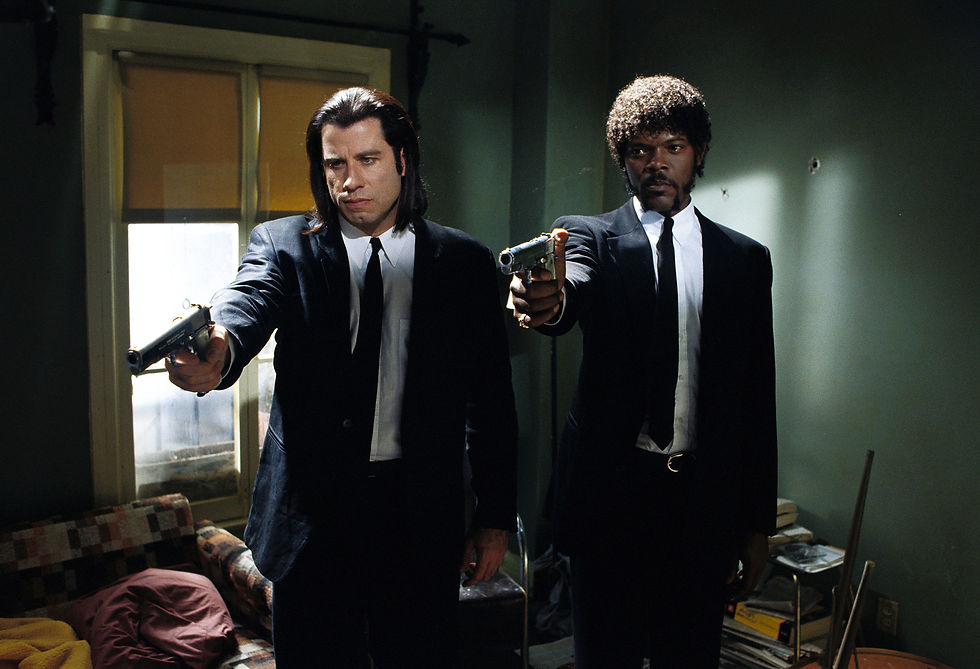
In terms of more professionally executed obscenities, you are leaving money on the table if you have Samuel L. Jackson on set and you’re not gonna have him call someone a “motherfucker.” Jackson had been bouncing around stage and screen for almost 20 years, most notably in four Spike Lee pictures, but Tarantino was the first to realize what a lyrical poet of vulgarity this man could be when given enough F bombs. Tarantino wrote the role of Jules specifically for Jackson after working with him on True Romance and it’s hard to imagine any other actor being able to deliver a fabricated bible passage with such fire in their eyes.
It isn’t just the excess that blew my adolescent mind when first viewing Tarantino’s seminal sophomore feature. This is a truly and wonderfully unique film. The magic marriage of Pulp Fiction’s nonlinear structure and rapid fire pop culture infused dialogue would be infinitely imitated in the years that followed but never quite replicated. The story is told all out of order with seven segments telling three interwoven pulp stories in addition to preludes, a flashback, a prologue and an epilogue, yet its propulsive plot remains easy to track as it zips along. What keeps things moving is the rich dialogue which refreshingly little of is explicitly expositional, yet even its most seemingly random bits reveal character and set up later narrative payoffs. Instead of having Bruce Willis’s Butch explain to his girlfriend why retrieving a watch is so important to him, Tarantino established its importance 20 minutes earlier by sticking in a lengthy monologue delivered by Christopher Walken about hiding the watch in his sphincter. Tarantino’s script doesn’t just come out and say Marcellus Wallace is the baddest gangster in all of LA. Instead he stages a long discussion between Jules and Vincent about the implied intimacy level of a foot massage and whether or not that justified Marcellus dropping one of their associates from a four story roof through a greenhouse below. This bit of small talk between these two perfectly establishes the perilousness of the situation characters later put themselves in by crossing Mr. Wallace.
In another bucking of convention, the film has no traditional score and instead its vivid soundscape relies on Tarantino and his music supervisors Chuck Kelley and Laura Lovelace’s impeccable ears for needle drops. The de facto theme song Dick Dale’s 1962 surf rock cover of Mediterranean folk song “Miserlou” that plays over the opening credits gets the blood flowing like few songs could. Will.I.Am knows. There’s a whole slew of eclectic selections that liven up the proceedings like “Rumble” by Link Wray, Urge Overkill’s cover of Neil Diamond’s “Girl You’ll Be A Woman Soon” and “Surf Rider” by the Lovely Ones. Second only to Miserlou the best pull may be “You Never Can Tell” by Chuck Berry soundtracking the return of Saturday Night Fever’s own John Travolta to the dancefloor of the silver screen.
Revelatory nature aside, perhaps the aspect of Pulp Fiction most near and dear to my own heart, is that it inspired one of the truly great Simpsons episodes, “22 Short Films About Springfield.” This in turn gave the world knowledge of delicious steamed hams.
I think my Mom owes Quentin an apology.
Honorable Mentions: Clerks, The Shawshank Redemption, Forrest Gump, D2: The Mighty Ducks
1995: Babe

Rotten Tomatoes Score: 97%
Where to Watch: Available for rental, the Babe and Babe 2 combo pack is well worth $8 to own
What better follow-up to Tarantino’s transgressive masterpiece than one of the sweetest most heartwarming films ever made. Late in Pulp Fiction, Jules and Vincent have a discussion about how Jules will not eat pork because he considers pigs to be a filthy animal. Jules notes that he would lift this “filthy” designation if pigs had a better personality but, “We’d have to be talking about one charming motherfucking pig. At least ten times more charming than that Arnold on Green Acres.” Babe is that pig.
A little sheep herding pig on a farm full of talking animals seems easy to dismiss as “pure whimsy,” just as James Cromwell’s modest Farmer Hogget does his initial thoughts of training the pint size porker, but Babe is a truly moving storybook fable about the power of kindness. Storybook is not just a cutesy exaggeration either as the film comes complete with chapter titles spouted by singing mice and narration delivered by the soothing baritone of Roscoe Lee Brown, the voice of Kingpin on one of my other childhood favorites, the Spider-Man animated series. An Academy Award winning mix of live animals and still impressive animatronic work done by Jim Henson’s Creature Shop does wonders to bring the Hoggets’ farm vividly to life. This magical film was justifiably nominated for 6 additional Oscars including Best Picture.
After countless childhood rewatches I once convinced my family to rent its inferior twin film Gordy, about a talking pig also looking to avoid slaughter. It seemed like an unimpeachable premise given the magic of Babe. Unfortunately we quickly discovered that despite releasing first and featuring an original song by Tag Team, Gordy had not one ounce of the charm. There is a deceptively difficult alchemy at work that set’s Babe apart from many of its treacly or juvenile family film peers.
Babe’s narrative balances some genuine darkness with love and a moving tale of acceptance. There are some upsetting moments in this film. Not as many as the truly traumatizing George Miller directed sequel Babe: Pig in the City but still a surprising amount for G rated fare. The opening scene is Babe’s mother being whisked off to slaughter and replaced by a cold metallic feeding machine. Multiple farm animals die and the story co-penned by Miller is quite frank about the fact that most humans eat various animals on the farm. Yet it is this intermittent gloom that makes the moments of triumph and gentle sweetness at its core, all the more powerful. Director Chris Noonan plays further with this power of contrasts in crucial interactions between James Cromwell’s Farmer Hoggett and Babe.
Little known at the time, the imposing 6’7” Cromwell was impeccably cast as a gruff man of few words. On the other end of the spectrum you have this talkative diminutive pig voiced by Christine Cavanaugh who gives Babe a nasally voice full of the strikingly similar sweet naivete she imparted to Chuckie Finnster on Rugrats. Late in the film when Babe falls ill and refuses to eat, distraught over the knowledge that humans consume his fellow swine, Hoggett swaddles the pig in a blanket and sings the song “If I Had Words” to the little guy while hand feeding him with a baby bottle. The stoic Hoggett even rises and dances a jig full of grand leaps up into the air. So profound has his love and belief in the wee lad grown that he will go to any length to prevent Babe’s spirit from being broken. It’s no wonder the orchestral score performed by the Victorian Philharmonic Orchestra builds off this diddy as the moment is the emotional linchpin of the film.
On competition day the crowd laughs and the judges beg Hoggett to stop making a mockery of their herding contest yet Hoggett steadfastly guides his unorthodox herder out to the course to complete the task he knows Babe can do in his own way. Watching the quiet dignified manner in which this pig with a heart of gold politely herds the sheep through the course is a soothing balm in an increasingly chaotic world. As discussed, the film does not deny the darkness that exists in our world but rather shines a spotlight on the power of kindness and mutual respect to cut through all that noise. Likewise following Babe’s spotless performance, a farmer’s simple words cut through the roars of the crowd to give the film a perfect ending that still brings a glint to my watery eyes every single time:
“That’ll do pig, that’ll do.”
Babe has shown us all that contrary to what his adopted dog mom Fly instructed him in his first herding lesson, you do not have to think less of others or bend them to your will. Just as much can be accomplished through understanding and a kind word. It’s a message we could all do well to take to heart. As Ma the old ewe states, “Enough wolves in the world already.”
Honorable Mentions: Toy Story, Heat, Sudden Death, Billy Madison
1996: Happy Gilmore

Rotten Tomatoes Score: 61%
Where to Watch: Streaming on Peacock
Adam Sandler was my favorite actor well into my teen years, at least until he really started leaning into using the flimsiest of screenplays to launder family vacations. I saw You Don’t Mess with the Zohan opening weekend and at 15 found it to have a rather nuanced take on the whole Israel/Palestine conflict weaved between its extensive pubic hair jokes. Happy Gilmore is the gold standard of Sandler comedy and was essentially designed in a lab to be the favorite movie of any 10 year old boy: Sports, slapstick violence, whacky supporting characters, abundant cursing; it’s all here. Much to the chagrin of my late golf loving grandfather, I don’t think I’ve ever stepped foot on a driving range without attempting the Happy Gilmore swing at least once. Because of these factors and the frequency with which it used to air on Fox, this is the movie that I have without a doubt seen the most times in my life. Over 25 years later, it still holds up.
Sandler’s first starring effort 1995’s Billy Madison is a bit more transgressive and anarchic with its deranged musical interludes and deployment of Chris Farley and Norm McDonald. Here Sandler reigns it in a bit and sets a simple template that he and his most frequent collaborators co-writer Tim Herlihy and director Dennis Duggan would replicate throughout Happy Madison productions for decades to diminishing returns. We have a stunted man child with anger management issues, an attractive woman impossibly infatuated with him (pre-Modern Family fame Julie Bowen), and celebrity cameos, the pinnacle of which was set here by an MTV Best Fight award winning performance from The Price is Right host Bob Barker.
The tremendous supporting cast collected here is likely buoyed by Sandler not yet having enough box office pull to just cast his drinking buddies. Christopher McDonald’s Shooter McGavin is the most iconic villain in all of sports comedy. The smarm, the finger guns, the pretentious sweater draped over the shoulders, the 9 o’clock on the 9th green gag, it’s all delightfully detestable. A surprisingly loquacious Richard Kiel and his monstrous 7’2 former Bond villain frame steals every scene he appears in as Happy’s former boss Mr. Larson. Apollo Creed himself, Carl Weathers, shows off some surprising comedic chops as Happy’s mentor Chubbs. SCTV veteran Joe Flaherty is hilarious as a tormenting heckler who just wants to befriend Shooter. There’s a far darker timeline where an insufferable mugging Rob Schneider plays the menacing handlebar mustachioed nursing home attendant but, since it’s 1996, we get an uncredited Ben Stiller before There’s Something About Mary launched him into his own studio comedy superstardom. Frances Bay is cemented as the sweetest old lady in the world playing Happy’s beloved grandma the same year she had her rye bread stolen by Jerry Seinfeld. As a devout Mad TV household growing up, it was a hoot seeing a young Will Sasso pop up as Mover #1 during rewatches. As I acclimated to the slightly more sophisticated SNL and Late Night with Conan O’Brien it became equally fun to find out writer Robert Smigel, aka Triumph the Insult Comic Dog, was the IRS man Happy throws through his Grandma’s front door.
Beyond the performances, there are some truly brilliant pieces of comedy writing in this film:
In addition to that perfect exchange, there are countless phrases that permeated the elementary school lexicon. I don’t think life on the playground or time spent at youth sports practices would have been the same without the uproarious laughter produced by non sequitur interjections of:
“You’re gonna die clown!”
“Go home! That’s your home. Are you too good for your home?!”
“You suck, ya jackass!”
“It’s all in the hips”
“You can trouble me for a warm glass of shut the hell up.”
With the timeless appeal of Sandler’s shenanigans and TBS still filling a 24 hour slate of programming, I don’t foresee a world where that ubiquity changes any time soon.
Honorable Mentions: Fargo, Swingers, Muppet Treasure Island, Sling Blade
1997: Face/Off

Rotten Tomatoes Score: 92%
Where to Watch: Available for Rental, I don't know a better way to spend $3
Nicolas Cage is a fascinating actor that I have always appreciated both for his performances and general eccentricity. By birthright, he is Hollywood royalty but he quickly dropped the Coppola moniker to carve his own path. He gave one of the greatest comedic performances of all time in the Coen Brothers’ Raising Arizona. In 1995 he won the Best Actor Oscar for his harrowing performance drinking himself to death in Leaving Las Vegas then immediately pivoted to action fare and became one of the most bankable stars in the world with The Rock, Face/Off and Con Air all releasing in a two year span. He was even involved in pre-production on a scrapped Tim Burton reboot of Superman during that period. He’s worked with visionary director like Martin Scorsese, David Lynch, Brian De Palma, Werner Herzog, Ridley Scott and his uncle Francis Ford Coppola. He’s also starred in bargain basement direct to video schlock directed by folks that don’t even have Wikipedia pages to help pay for his castle and dinosaur bone purchases. With Face/Off, Cage displays the full gamut of his skill and bizarro energy in a film that is the pinnacle of 90’s action excess.
The entire premise of Face/Off is the exact kind of action movie stupidity that transcends into brilliance when executed properly. When infamous international terrorist Castor Troy winds up in a coma without revealing the location of an active bomb, FBI agent Sean Archer must undergo an experimental face transplant surgery in order to assume Castor’s identity and coax information out of his imprisoned brother Pollux. That’s right, Archer literally takes Troy’s face off. Would you believe it, Castor Troy then awakens and steals Archer’s currently unused face to impersonate him as well. It is a modern retelling of The Prince and the Pauper that Mark Twain was surely kicking himself in the grave for not writing.
Cage is frankly bonkers in this movie. In the opening scene he has the fakest looking mustache I’ve ever seen for some inexplicable reason. The next scene he is disguised as a priest but immediately destroys any pretense of an effective disguise by gyrating wildly and groping a choir girl. Throughout the film Cage is just making the wildest of faces. The human eye was not meant to open as wide as he expands his lids. He is constantly touching people’s faces with this same bizarre finger brushing movement that not a soul has used before or since. Cage expresses every emotion known to man often in rapid succession as his version of Sean Archer battles the identity crisis of his subterfuge. He throws up a Jordan Shrug after tossing a slain FBI agent out of his getaway plane. Cage also delivers a huge win for “a character says the title of the movie” enthusiasts like myself here:
It is the performance of a one of a kind artist at the height of his craft firing on all cylinders.
As wild as Cage’s performance is, John Travolta may be having even more fun because after the face swap, he gets to pretend to be Nicolas Cage. He’s sassy, adopting a wildly unpredictable volume, cadence, and rhythm of speech and does his best to match the wild eyed lunacy of his co-star. Face/Off was originally envisioned as a Sylvester Stallone and Arnold Schwarzenegger vehicle, but it’s hard to imagine those two thespians having quite as much success impersonating the performance tics of their roided out counterparts.
While the acting is a major draw, the true significance of Face/Off is that it is the only American production to fully utilize the vast talents of visionary Hong Kong action director John Woo (Mission Impossible II has one cool motorcycle sequence but is otherwise an absolute snooze. His first stateside feature, the Jean Claude Van Damme “The Most Dangerous Game” riff Hard Target, is actually pretty fun. A cajun Wilford Brimley blows up a slew of bad guys with a bow and arrow and some dynamite). Not to go full Stefon but this film has everything: Cage dual wielding golden handguns, shotgun blasts that hurdle victims 10 ft through the air, characters diving and sliding all over the place while firing their weapons, a 4-way Mexican standoff, a shootout at a funeral where doves and pigeons fly amok, a harpoon gun, duster jackets flapping in the wind, a futuristic floating prison complete with bulky magnet boots that can lock prisoners in place, Cage and Travolta shooting their own reflections in a room ludicrously full of mirrors, and a slow motion firefight set to “Somewhere Over The Rainbow.” Never have hair plugs taken a beating like they do in the incredible speed boat chase Woo stages between Cage and Travolta. During that sequence Woo does this move common in Hong Kong action cinema where he shows multiple different cuts of a big action moment in rapid succession.
Known as a stutter cut, when deployed here the editing technique lets the audience know, “Yes, we really did jump that boat off another exploding boat and we have multiple angles of camera coverage to prove it.”
I don’t know if the negative health effects of heavy cocaine usage have been too properly disseminated amongst Hollywood producer circles or what, but they simply do not make blockbuster action movies like this anymore.
Honorable Mentions: Men in Black, Cop Land, Boogie Nights, The Fifth Element
1998: The Big Lebowski

Rotten Tomatoes Score: 83%
Where to Watch: Available to Rent. Your friend who takes edibles has a DVD copy you can probably borrow
As a native Minnesotan, there was no way I was going to make it through this list without a Coen Brothers appearance. Throw in a Bob Dylan tune over the opening credits and you’ve got a hot dish of entertainment I won’t even politely decline twice before accepting. Minnesota connections aside, the mantra of “Fuck it dude, let’s go bowling.” speaks to me deeply as someone whose friends rotated purchases of a glitched out Groupon for years to become regulars at Drkula’s 32 Bowl. There really is no cleverer disguise for just going to a bar and talking with your friends than the intermittent action of a game of ten-pin. The Big Lebowski deploys a similar subterfuge for low stakes entertainment.
The plot centers on a complex sprawling kidnapping case that a consistently stoned layabout has been tasked with solving. The film becomes richer on subsequent viewings when it becomes apparent that the solving of said case doesn’t really matter. I’m sure there’s a number of tedious essays and Youtube videos that can “explain” why the film takes place at the start of the first Gulf War but I’m not entirely convinced it isn’t just an excuse to have The Dude parrot back “This aggression will not stand” after seeing the George Bush speech earlier on TV. The convoluted story full of twists and turns is really just a delivery vehicle for some great gags and unmatched comedic character work.
In this way, Lebowski is not dissimilar to one of my most beloved television programs, The Simpsons. A lot of the same elements are there. Both deliver fanciful dream sequences complete with old time Hollywood musical numbers. Lebowski’s fabricated former Branded writer that now lives in an iron lung is a Conan O’Brien era Simpson’s gag if I’ve ever heard one. Phillip Seymour Hoffman strikes a distinctly Smithers like figure as a millionaire’s kissass assistant Brandt. This sequence is a Homer Simpson bit complete with the startled squeals:
Jeff Bridges so fully inhabits “The Dude” that in subsequent years it’s become increasingly difficult to discern between the two. He’s a lackadaisical bum that goes grocery shopping in a robe and swigs half and half straight from the carton when he isn’t licking the remnants of his latest white russian out of his beard. Throughout the film the Coens and Bridges sprinkle in hilarious little details that speak volumes to the employment optional lifestyle of The Dude. He writes a check for 69 cents and is consistently seen smoking the remnants of roaches so miniscule he has to deploy tweezers to hold them. Bridges’ dedication to verisimilitude went as far as supplying his own leisurely wardrobe and rubbing his eyes to produce redness between takes if he suspected The Dude would have toked up on his way to a location.
Walter Sobchak may be an even more brilliant comic creation with John Goodman delivering his best screen performance as the unhinged Vietnam veteran. Adorned with a flat top and gladiator beard, Goodman conjures a consistent model for some of the more infuriating rhetoric of today. Sobchak is a hardcore stickler for law and order, as he notes to competitor Smokey when accusing him of line crossing, “This is not ‘Nam, this is bowling, there are rules.” Walter also steadfastly refuses to bowl on Saturday as he cannot partake in any activities on Shomer Shabbos. Yet Walter’s own adherence to rules is quite selective. Walter is not above pulling a loaded gun at a bowling alley to settle an argument or trying to steal $1 million in ransom money with an uzi and a decoy bag full of his undies. In a now all too familiar tactic, Walter is also quick to invoke the first amendment as some sort of get out of jail free card when he is threatened with expulsion after repeatedly shouting curse words in a family diner at full volume. He also childishly assures his friend “I’m calmer than you are,” after The Dude accosts him for publicly threatening a man's life with a firearm not minutes before. Walter thinks of himself as a brilliant tactician from his years of combat yet his proposed plan for getting the location of the missing Bunny Lebowski is to simply grab one of the kidnappers at the money drop and beat the information out of them. Walter was the original Oakley Glasses in the comment section years before social media even existed.
Much like the denizens of Springfield, the supporting characters of Lebowski are a cavalcade of distinct weirdos. Walter repeatedly tells his bowling teammate Donnie he is out of his element but Steve Buscemi certainly was not while portraying an affable loser just happy to be out and about with his buddies no matter how verbally abusive they are of him. Coen mainstay John Turturro makes an undeniable impression as purple jumpsuit clad pederast Jesus Quintana in just two brief vibrant appearances. David Huddleston proves a fantastic foil to the Dude as the blustering titular Big Lebowski who resides in a sprawling mansion looking down on others and trafficking in bootstrap rhetoric while partaking in his own blatant debauchery and having done nothing to earn his own wealth and influence. Julianne Moore unlocks a specific form of pompous weirdo by doing a Hepburn-esque mid-Atlantic accent as the experimental artist/heiress Maude Lebowski. The Dude’s landlord has an interpretive dance quintet. Apologies to Nietzsche who I’m sure wrote some lovely manifestos and diatribes I Sparksnoted to get through Intro to Philosophy but the lingonberry pancake craving Germans who “believe in nothzing Lebowski'' are who really formed my understanding of the worldview of nihilism. Sam Elliot and his comically bushy mustache preside over it all as an omniscient cowboy narrator that may or may not be God. This rich tapestry of oddballs really does tie the comedy together and is why 25 years later the film still abides.
Honorable Mentions: A Simple Plan, Out of Sight, Blade, The Mask of Zorro
1999: The Straight Story
Rotten Tomatoes Score: 95%
Where to Watch: Streaming on Disney+
This is probably the most obscure movie that will appear on this list but it is accessible on a major streaming service and I could not more highly recommend it. David Lynch, master of the surreal, known for making dark bizarre dream like film and television projects (Blue Velvet, Twin Peaks), directs a G rated film distributed by Disney about an old man that drives his lawnmower from Iowa to Wisconsin to see his estranged brother who has recently suffered a stroke. In the process Lynch creates one of the most outright beautiful films about middle America and life in general ever made. The story will wreak havoc on your emotions at multiple turns, none more powerful than its simple and stirring ending which leaves me misty eyed whenever I even think about it.
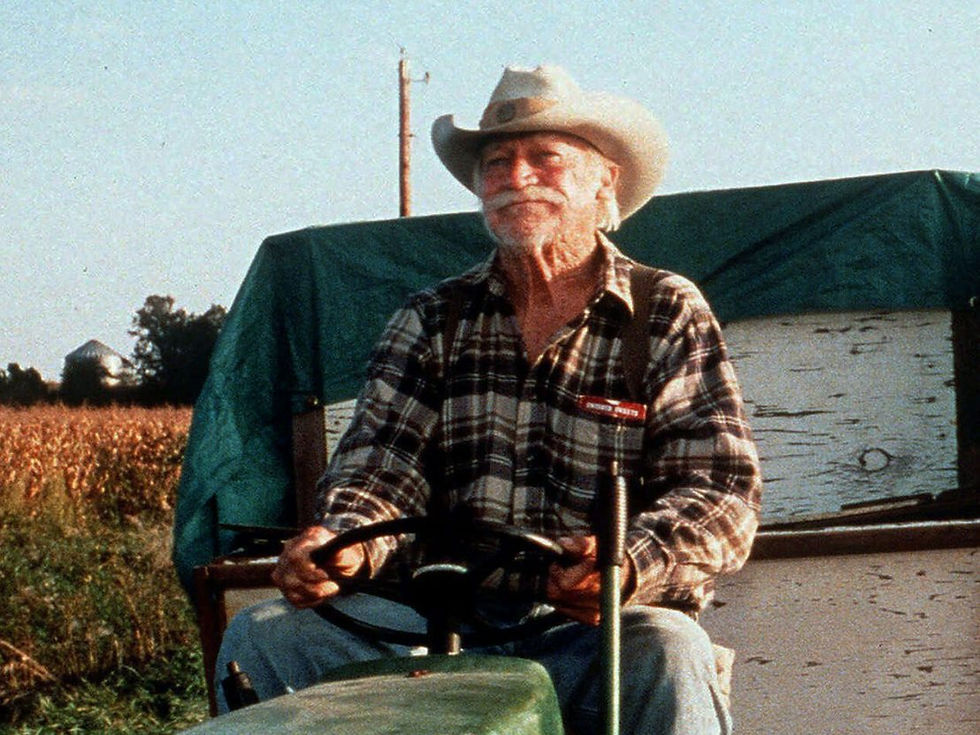
There is no bigger factor in The Straight Story’s success than a masterful performance from 79 year old lead actor Richard Farnsworth. The performance is all the more incredible when you learn Farnsworth was suffering from terminal cancer while shooting the film. The difficulty walking and paralysis in the legs of his character are real ailments Farnsworth was suffering at the time. When news of Alvin’s brother Lyle’s stroke arrives, Lynch wisely keeps the camera locked in on Farnsworth’s face as Alvin’s daughter Rose (a stellar Sissy Spacek) receives the call in the other room and passes the information to her father. Farnsworth doesn’t say a word but the subtle emotions that sweep over his weathered scraggly visage say a thousand. He would justly earn a Best Actor nomination for this, his final film appearance.
The second great element of this film is the profoundly moving acoustic guitar and string based score by Lynch’s signature composer, the late great Angelo Badalamenti. The music creates the perfect accompaniment for multiple montages of beautiful sweeping aerial shots of the seemingly endless fields and rolling hills that populate the dusty country back roads of Alvin’s journey. Badalamenti does especially great work with a mournful final stretch as Alvin approaches his destination and years of bottled up emotions begin to surface.
It is a testament to the strength of the screenplay that a singular filmmaker like Lynch would be so willing to take it on. In fact, it is the only one of Lynch’s 10 films for which he does not share a screenwriting credit. When presented the screenplay for a read through by his long time editor Mary Sweeney and her childhood friend John Roach, Lynch was so taken by the potent emotions on the page, he simply had to make the film. Fitting with the material, Lynch displays a tremendous commitment to naturalism for a director typically locked in on creating a bizarre dreamlike atmosphere. In a highly unorthodox decision, Lynch shot the entire film chronologically along the actual path of the real life Alvin Straight. That path is populated with actors that don’t look like your typical Hollywood players but rather the real people you’d see around a small town.
There are a number of interesting moments where Lynch keeps the camera in the distance and the dialogue can just faintly be heard. It creates this feeling of someone just catching the exchange while passing through town, like a half heard conversation taking place across the street or over in a neighbor’s yard. It emphasizes the fact that folks with as rich and complex a life as Alvin Straight are going about their day to day all over these small town communities familiar to my own midwest upbringing.
The Straight Story truly is a quintessential film about midwestern hospitality. After the initial side eyes at his unorthodox means of transportation there is a striking amount of kindness shown to Alvin upon his journey. From the charter bus driver that takes him into town after his first mower breaks down, to the kindly couple that lets him camp in their yard while he awaits his latest repair, to the priest who offers him a warm meal when he spots his camp fire aglow, seemingly everyone Alvin encounters wants to help in whatever way they can. In exchange for their kindness Alvin offers them all some simple hard earned wisdom the trials and tribulations of life have afforded him. With each passing conversation viewers learn more and more about Alvin and why he is so determined to complete his journey. There’s more than just physical health on Alvin’s mind when he tells some inquisitive cyclers, “The worst part about being old is remembering being young.” Haunted by a pile of regrets, he hopes desperately for redemption, reconciliation, and to salvage what remains.
The film avoids slipping into the melodrama of a standard weepy tearjerker by being just what the title implies, a simple story told plainly and quietly that stands on the strength of its authenticity.
Honorable Mentions: The Iron Giant, Office Space, South Park: Bigger, Longer, Uncut


Comments