

Wattching Hockey: A Wild Run
- Watt

- May 23, 2018
- 13 min read
Updated: Apr 15, 2020

On this past Sunday afternoon the Vegas Golden Knights defeated the Winnipeg Jets 2-1 to win the Western Conference Finals 4 games to 1 and clinch a spot in the Stanley Cup Finals in their very first year of existence. That was a long and rambling sentence but I am far too flabbergasted to apply grammar to this situation. This victory is an unheard of feat for a modern expansion franchise, not only in hockey but in the entire realm of sports (NOTE: 50 years ago the St. Louis Blues did make the 1968 Stanley Cup Final in their inaugural season, of course aided by the technicality of playing in a division made entirely of their fellow expansion teams, including both the Minnesota North Stars and something called an Oakland Seal. The players were also helmetless, shooting with tree branches and smoking packs of menthols between periods so it doesn’t quite compare). It is simply an outcome that if anyone who tells you they predicted it, they are a liar and a scoundrel. This shocking accomplishment got me thinking about my own favorite team of scrappy expansion underdogs. I of course, refer to the immortal 2002-03 incarnation of the Minnesota Wild.
Like the Golden Knights, life began for the Minnesota Wild through an expansion draft, this one conducted the summer prior to the 2000-01 NHL Season. In an expansion draft players from existing NHL teams are selected by the expansion teams to fill their roster. Teams are able to protect most of their players (in the 2000 draft 1 goalie, 5 defensemen, and 9 forwards or 2 goalies, 3 defensemen and 7 forwards whereas teams could only protect 1 goalie, 7 forwards and 3 defensemen or 1 goalie and 8 position skaters regardless of position in the Vegas expansion draft) so the Wild had to pick from the bottom of the barrel in terms of NHL talent to assemble their first roster. In fact, the Wild were not the only team being added to the league that season as known hockey hotbed Columbus, Ohio had also been given a franchise in the form of the Blue Jackets. This dual expansion meant that not only were the Wild selecting from the scrap heap of the NHL, they were alternating picks of said garbage with their expansion brethren. This led to the selection of possibly made up players like Ladislav Benysek, Stefan Nilsson, and Sergei Krivokrasov, 2 of which whom don’t even have Wikipedia pages. Also selected 43rd overall in the expansion draft was Minnesota native Darby Hendrickson, who by almost every measure imaginable, was a bad pro hockey player. He would go on to score the team’s first goal, lead the team with 18 goals on the season, and is worshipped not unlike a god in our fine state.

Given this abysmal base, the Wild, like most expansion teams prior to Vegas, struggled out of the gates. Minnesota won only 25 games to finish dead last in their division and 14th in the Western Conference ahead only of a previous expansion team named after the greatest trilogy of Disney movies ever made, while scoring a league low 168 goals. The second season would prove to be much of the same with only a slight improvement to 26 wins and another finish at the bottom of the Northwest Division. However, there were a few intriguing pieces from which to build upon.
The day following their initial expansion draft, the Wild selected 18 year old Slovakian Marian Gaborik 3rd overall in the 2000 NHL Entry Draft. My non-Minnesotan readers may be familiar with Gaborik as the guy who missed 20-30 games every season with a pulled groin on recent L.A. Kings teams. But who am I kidding, no one pays attention to the L.A. Kings, and if they did, they’re certainly too busy with degenerate gambling addictions to read random strangers' hockey blogs. Gaborik would quickly become a fan favorite, an easy choice as he was blatantly the most talented player on the team with elite speed and one of the nastiest quick release snap shots that have ever graced the league. He would score a respectable 18 goals to tie for the team lead with the aforementioned Hendrickson in his rookie season. It was a promising showing for a teenager adapting to the more physical North American style of play and catching passes from the soon to be gym teachers employed as his initial teammates.

Gaborik would go on to further develop his eye popping talent and speed to score 30 goals to again lead the team in his 2nd season. He followed that up with the first ever All Star Game appearance by a Wild player and 30 more team leading goals during the ’02-03 season of which this fevered rambling is most concerned. Frequent injuries and feuds with the coaching staff and management would later sully and derail his time in Minnesota but he remains the team’s leading goal scorer and arguably the greatest player in its relatively brief history.
Where the Vegas Golden Knights have installed Coach of the Year Gerard Gellant, foolishly cast aside by the Florida Panthers, so too did the Wild have an undervalued strategist in the form of former Stanley Cup Champion and Jack Adams Trophy winner (i.e. Coach of the Year. The NHL in an effort to grow the game and appeal to youths likes to call all their trophies by the old person you never heard of that they are named after instead of what they’re for) Jacques Lemaire. Lemaire employed his vaunted and conversely much maligned in the media “trap” system to optimize the performance of a team built around a bunch of scrappy journeyman and inexperienced youngsters. Simply explained the system clogs the neutral zone between the two blue lines to prevent smooth transitions and opposing teams from gaining the odd man rushes which generate the highest chances of scoring goals. This effectively turns each game into a rock fight of dump and chase hockey that generally will end in a low scoring 2-1 or 3-2 game. Aesthetically pleasing it was not, but an effective strategy to steal games when some of your primary offensive weapons are players like Jim Dowd (once scored 13 whole goals in an 82 game NHL season), Antti Laaksonen (managed to crack 30 pts not once, not twice, but 3 times in his 8 year NHL career. Never could get to 35) and Wes Walz (scored 35 goals one season, 10 years prior, in the minors).
The 2002-03 squad was once again going to be a team of mutts. A collection of has beens, and never weres with just a sprinkling of promising young guns including then 20 year old D-man Nick Schultz and freshly drafted 18 year old center Pierre-Marc Bouchard who would go on to play the 2nd and 3rd most games in franchise history respectively. The big free agent signing in the offseason was Cliff Ronning, a 37 year old journeyman who was no stranger to expansion teams, having been a member of both the first Phoenix Coyotes team in ‘96-97 and the first Nashville Predators team in ‘98-99. He would finish 3rd on the team in scoring with 48 points. But much like that old dog Patches you pick up at the pound, these mutts would get the job done and bring joy to children everywhere.
In order for Lemaire’s low scoring mucking and grinding strategy to work, the Wild needed strong goaltending play. This key to success for the ‘02-03 team came in the form of an unexpected tandem. Unlike Vegas, who was gifted an elite and playoff proven goaltender in the form of Marc-Andre Fleury in their expansion draft, the Wild had to make due with what seemed like spare parts between their pipes.
Nepotism is generally frowned upon in most situations however the Wild pulled off a brilliant move when prior to their inaugural season they traded a 3rd and 4th round pick to the Dallas Stars for Jacques Lemaire’s nephew Manny Fernandez. Fernandez joined the team as an unheralded backup goaltender with a total of 33 unimpressive NHL games played in his 5 year career. He would go on to win a respectable 113 games, while playing at least 35 games each of the 6 years he was employed by the Wild. He would have the strongest year of his career for the 2002-03 team going 19-13-2 with a stellar .924 save percentage and a 2.24 goals against average.
In the summer of 2001, the Wild signed 32 year old Dwayne Roloson, an undrafted backup goalie who had spent the entire previous season in the minor leagues. It was a roll of the dice to say the least but with previous starting goaltender Jamie McLennan having gone 5-23-9, there wasn’t a whole lot to lose. Sure enough Roloson, or Roli the Goalie as he would come to be known, would beat out McLennan for the rotation spot during training camp. After 45 games of solid play in the ’01-02 season, the dice rolli paid off handsomely as Roloson went 23-16-8 while posting an even superior to Fernandez .927 save percentage while allowing an even 2.00 goals against average good for 2nd and 3rd in the entire league respectively. Combined these two unlikely netminders would form the backbone of the 2nd stingiest defense in the Western Conference for the ’02-03 season, conceding only 178 goals over the 82 game season.

The value of this shutdown tandem was tremendous as the Wild themselves only potted 198 goals, the 3rd least in the Western Conference that season. In fact, unlike the offensive machine assembled by the Golden Knights who had five players with 20 or more goals this season including an absurd 43 by William Karlsson, the Wild only had two players hit the 20-goal mark (Gaborik with 30, and all-time great French Canadian hockey namehaver Pascal Dupuis with 20). The goals may not have come in bunches but when they did, the team would bunker down into Lemaire’s suffocating neutral zone trap to make sure the other team would have few opportunities to answer back. This system clicked for the team as they went 42-29-10-1 (Win-Loss-Tie-Overtime Loss (Yes the NHL used to have ties before shootouts, but for some reason would also still give you a point if you lost in overtime. It is a silly league)) to finish 6th in the conference and earn their very first playoff dance with the Colorado Avalanche.
Colorado was an absolute juggernaut led by future NHL Hall of Famers Peter Forsberg, Joe Sakic, Rob Blake and Patrick Roy, inarguably a top 5 goaltender in the history of the league. The team was a staple at the top of the league since their 1996 relocation from Quebec having made the previous 4 Western Conference Finals and winning 2 Stanley Cups. If you played the NHL video game series at any point from 1997 to 2003, you essentially started every game by deciding who was going to be the Avalanche and who was going to be the Detroit Red Wings.
Remember how Gaborik led the Wild with 30 goals? Yeah, Milan Hejduk had 50 for the Avs. He wasn’t even the Avalanche’s biggest offensive threat as he was outshone by league MVP Forsberg and his league leading 106 points. To say Colorado was favored in the series would be a bit of an understatement.
The Wild paid no mind to expectations and promptly announced their arrival to the league’s biggest stage with a stunning 4-2 Game 1 victory in Denver. Led by the powerplay scoring of Gaborik and expansion draft selection Filip Kuba, and backed by a 39 save performance from Roloson, Minnesota made sure the Avalanche knew this series wasn’t going to be the cake walk it looked like on paper. The Avalanche, no doubt startled by their defeat at the hands of the league’s leftovers, promptly stepped on the gas and methodically defeated the young upstarts 3-2, 3-0, and 3-1 in the 3 successive games. It looked as though the series was going to end the way it was predicted afterall. If the existence of multiple paragraphs following this one hasn’t tipped you off to the actual conclusion of the series, please read on in continued suspense.
While Minnesota found themselves deep in a 3-1 hole in the series and headed back to Denver, they still had the confidence of that initial victory that told them they could hang with the big boys. The team came out buzzing jumping out to a 3-0 lead late in the second period on an absolute rocket by Pascal Dupuis (I don’t have a Youtube clip for this goal but I do remember trying to take slapshots and wildly missing nets the whole next week at practice trying to recreate it). The Wild would then batten down the hatches and weather a 3rd period storm by the Avalanche to pull off the 3-2 victory. This was aided in no small part by 28 saves from Manny Fernandez as the Wild’s goalie rotation continued into the playoffs. What comes next in the series are some moments I’m fairly confident I will be able to describe in vivid detail to my grandchildren on my deathbed while they try to pester me about who will get the lake house.
The Wild returned home to St. Paul for pivotal game 6. This was an elimination playoff game played in Minnesota, the very “State of Hockey.” Over 19,000 fans packed into the 18,064 seat Xcel Energy Center 10 years after their beloved North Stars had been stripped from them and relocated to Dallas. The place was buzzing to say the least. The tension and excitement only built as the teams skated to a scoreless first two periods. The teams then exchanged pairs of 3rd period goals to head into overtime all knotted up 2-2. Roughly 4 min into overtime the puck found its way over to Wild winger Richard Park, the greatest Korean born NHL player of all time. Pandemonium would ensue as he ripped a wicked wrister far side past a stunned Patrick Roy to give the Wild the 3-2 win and force a game 7 back in Colorado.
But let me tell you, this incredible moment was just the appetizer. I remember watching Game 7 on my couch at home the same way old people remember watching Neil Armstrong climb out on that soundstage to fake the moon landing all those years ago. The teams traded goals in quick succession from the usual suspects: Forsberg for the Avs answered a minute later by Dupuis of the Wild in the second period. Joe Sakic for Colorado and Marian Gaborik 2 minutes later for Minnesota in the 3rd. Once again, a 2-2 game was headed to overtime.
This is where the pinnacle of my lifelong sports fandom occurred. Just over 3 minutes into the extra period Sergei Zholtok, the greatest Latvian born hockey player of all time (the Wild really cornered the market on countries that rarely produce NHL players) took the puck across center ice, baited two Avalanche defensemen to both pinch in on him and left a beautiful drop pass for a streaking Andrew Brunette. Brunette, never the most gifted skater, slowly glided far to the left of the goal, then slid back towards the middle of the ice with the puck on his backhand. Patrick Roy was ill positioned and possibly hypnotized by the glacial movement occurring in front of him. He could only look on in horror as Brunette gently deposited the puck into the back of the net. You may not have been clicking the on links previously in this post but I’m really going to ask that you click on that one because it is in my unbiased opinion the single greatest moment in the history of sports. This goal won the game, won the series, and kept me awake for at least another hour on a school night as I waited to see how many times the replay would be shown on the local news. While I was in ecstasy, the devastation of these back to back overtime losses mentally broke Patrick Roy and forced him to retire never to play hockey again. Or he was just 37 with worn out hips from playing over 1000 NHL games, but I like to think the former was the case.
After vanquishing the Avs, the Wild took on their most hated of division rivals, the Vancouver Canucks. They had all the staples of a classic team of villains: They wore black, deployed evil twins, had a giant goon named Todd Bertuzzi who scored 46 goals and later broke a guy’s neck, and worst of all played in the Pacific Time Zone so you had to stay up past midnight to even see the end of their games. Truly the scum of the earth. Vancouver was also the Wild’s chief rival in employing confusing animal logos:

Just as in the previous series, Minnesota found itself in a 3 games to 1 hole. While it may have seemed as though the Wild were simply outmatched by a superior and experienced opponent, all 4 games had each been decided by a single goal with 2 of the losses coming in overtime. Through the 4 games, something had stood out to me, your diehard 10 year old fan, as a potential weak spot on Vancouver for the team to expose. This of course being the beer leaguer the Canucks had employed in goal full time by the name of Dan Cloutier.
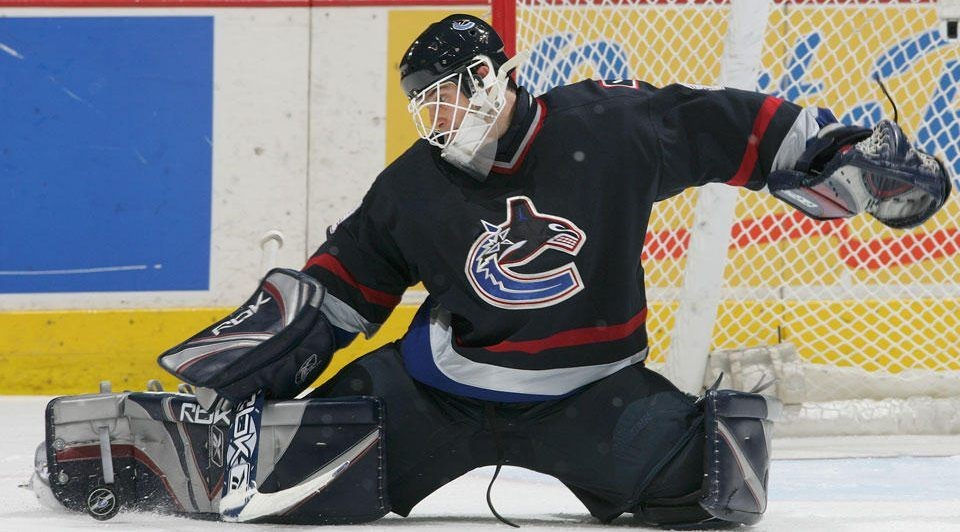
Lemaire, brilliant hockey mind that he was, saw the same inherent weakness in playing a man that had clearly only strapped on the pads because goalies get to play Rec League for free. He adjusted his teams strategy of dumping every puck into the corner to instead passing some of these pucks to players that could shoot. Such players like Gaborik, Dupuis, Brunette and Ronning would then promptly snap the puck past the overwhelmed Cloutier to the tune of 7-2, 5-2 and 4-2 victories to complete the comeback and win the team's second 7 game series. Never before had an NHL team comeback from multiple 3 game to 1 deficits but this scrappy Wild team started to seem like they were never going to go away.
But as happens in sports and theoretical physics, an unstoppable force would run smack into an immovable object. This immovable object was Anaheim Ducks netminder Jean-Sebastien Giguere. Not only did the Wild’s next opposing goaltender have a real mask, but he also had some of the most blatantly oversized pads to ever grace an NHL rink.

After a thrilling 1-0 double overtime loss in game one, in which Giguere turned away chance after chance on the way to 39 saves it became apparent this was not going to be the Wild’s series. Giguere and his comical pads would impose their will on Minnesota and only give up 1 goal in the entire 4 game series. This included a 217 minute shutout streak to begin the series. For the mathematically disinclined, that is over 3 and a half games without giving up a goal. In the Stanley Cup playoffs, a team often goes as far as a hot goalie can take them and this guy was made of magma. In fact, Giguere was so dominate in the playoffs that he was award the Conn Smythe as the playoff MVP despite losing in the Stanley Cup Final, the last player to ever accomplish that feat (15-6 with a .945 SV%, 1.62 GAA and an absurd 5 shutouts. To put that number in perspective, Patrick Roy had the same number of shutouts in 63 regular season games that season). If this Wild team was going to bow out, at least they did so in historic fashion.
Thus concluded the ride of a lifetime for a young expansion franchise but obviously more importantly for the 10 year old boy tuned in often far past his bedtime to watch them on their journey. The franchise has never again advanced as far as the conference finals but has been perennially competitive since that magic season. I love each iteration and hope the best for all of them but I don’t think I’ll ever be as enthralled and invested as when this shiny new team filled with castoffs and nobodies gave the league a run for its money. For that reason, I envy every young Golden Knights fan out there. I hope they cherish the experience and one day years from now perk up to the sound of the names Erik Haula and James Neal the way I do for Richard Park and Andrew Brunette.


Comments